I think it was last week's Saturday, and I was sitting at one of my favorite cafés near the Brandenburg Gate, drinking lemonade and reading Karen Hao’s Empire of AI: Dreams and Nightmares in Sam Altman’s OpenAI. Not a bad setting for thinking about how a relatively small AI research lab grew into one of the most influential technology companies in the world.
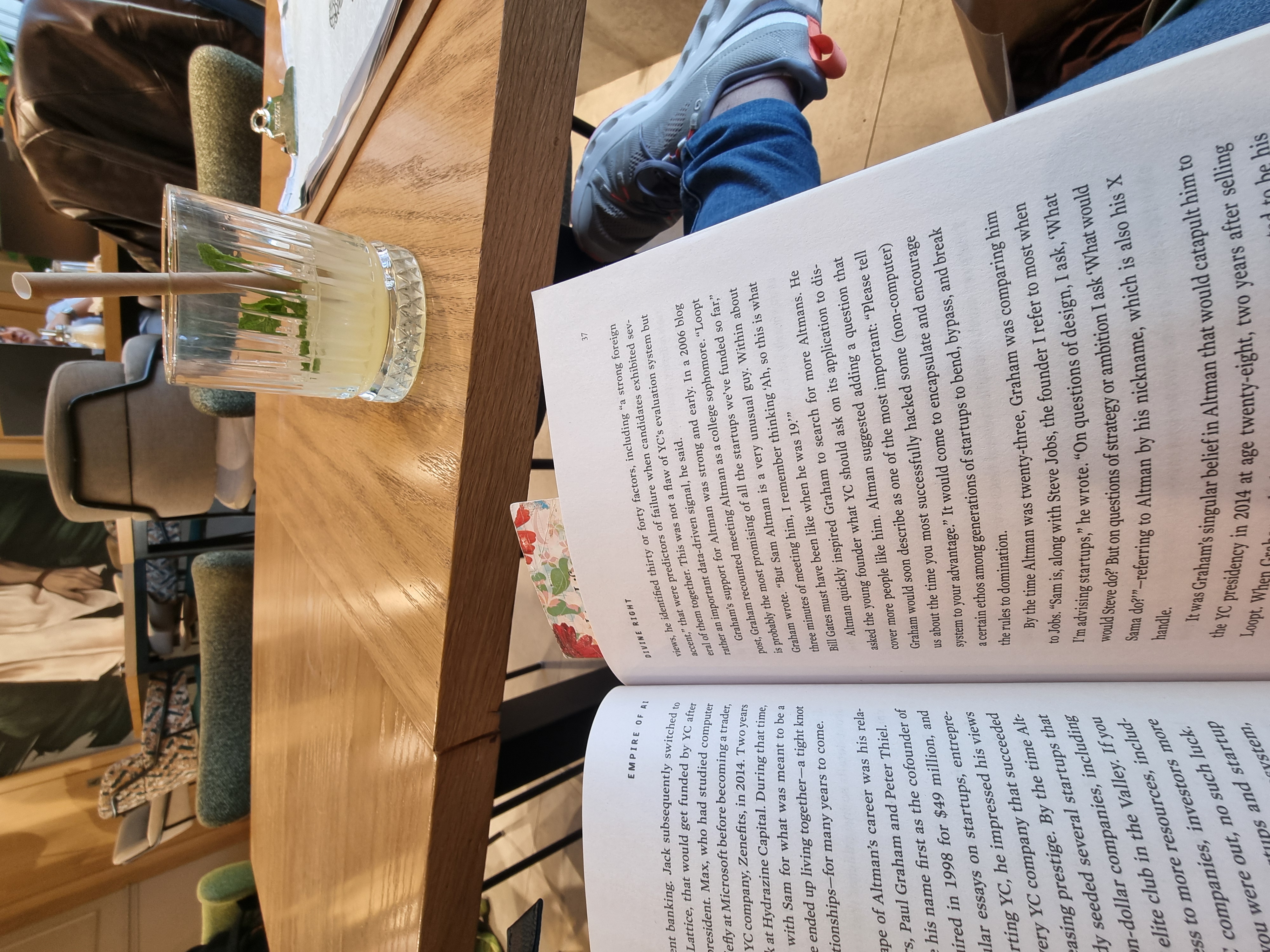
Published in May 2025, Empire of AI sets out to tell the story behind OpenAI and the people, ambitions, tensions, and consequences surrounding the rise of modern AI. Hao has covered artificial intelligence for years as a journalist, and that experience shows. There’s a lot of reporting here, and much of it is genuinely fascinating.
What I liked
For me, the strongest part of the book is the story of how OpenAI changed over time. Hao takes us back to its founding in 2015, when OpenAI presented itself as a nonprofit research lab with a mission centered on ensuring that advanced AI would benefit humanity. From there, she follows its evolution into a much more commercially driven organization, including its increasingly important relationship with Microsoft. That transition-from idealistic research organization to a company operating at enormous technological and commercial scale-is probably the most interesting thread in the book. Hao is particularly good when she gets into the details: internal disagreements, the Microsoft partnership, researchers leaving over concerns about the direction of the organization, and the unusual “capped-profit” structure OpenAI adopted as it tried to reconcile its original mission with the extraordinary amount of capital required to build frontier AI systems.
The section on Sam Altman’s dramatic firing and return in November 2023 is especially engaging. Even if you followed the story when it happened, seeing the events reconstructed as a continuous narrative makes the whole episode feel different. Hao draws heavily on reporting and conversations with people close to the events, which gives these chapters a real sense of immediacy.
Another part I appreciated was that the book doesn’t restrict the AI story to Silicon Valley executives, researchers, GPUs, and model benchmarks. Hao spends time looking at the people and communities further down the AI supply chain- including data annotators in Kenya who were tasked with filtering disturbing material, as well as communities affected by the water and energy demands associated with large data centers. Those sections are important because they remind us that “AI” isn't just an algorithm sitting somewhere in the cloud. Behind these systems are physical infrastructure, energy, data, labor, and a very large number of people.
Where I struggled with the book
My main hesitation is Hao’s central framing of AI development through the idea of empire.She draws parallels with historical systems of extraction and colonialism: powerful institutions accumulating resources, labor, data, infrastructure, and influence while some of the costs are carried elsewhere.There are places where this comparison is genuinely thought-provoking.
But for me, the book returns to the metaphor a little too often. At times I found myself more interested in the specific facts Hao had uncovered than in fitting those facts into the larger “empire” framework. And that’s slightly frustrating because the reporting itself is often strong enough to stand on its own. I also noticed a shift in tone throughout the book. Some chapters feel like careful investigative journalism, while others move closer to argument or commentary. Neither approach is inherently a problem, but moving between the two occasionally made me wonder where the reporting ended and the author’s interpretation began.
My takeaway
I’m glad I read Empire of AI.
If you’re interested in AI- not only in how the models work, but in the organizations, people, money, infrastructure, and power structures surrounding them- there’s a lot here worth thinking about. I wouldn’t necessarily read it as the final word on OpenAI or the AI industry. I’d read it as one deeply reported perspective on a complicated story that is still unfolding.And perhaps that is what stayed with me after finishing my lemonade: AI is often discussed as though it is primarily a technological revolution. But technology never develops in isolation. There are always people making decisions about what gets built, who pays for it, who benefits from it, and what trade-offs society is willing to accept.
Empire of AI is at its best when it makes those usually invisible parts of the story visible.